
Beyond Borders: European Travel Payments Summer 2026 Analysis
Sep 2026
•
12 min read

Overview
Executive Summary
European travel entered summer 2026 with resilient demand and growing international activity. In H1 2026, foreign-visitor nights increased 2.5% year on year, compared with 0.9% growth in domestic nights, and represented 48.9% of EU tourist accommodation nights.
The ECB's latest comparable consumer payment study shows substantial country-level differences in how consumers pay online, while locally embedded payment methods continue to operate at significant scale.
Taken together, the evidence supports a central conclusion for travel payments:
Cross-border travel does not mean uniform payment behaviour.
For OTA merchants, this makes the traveller's source market relevant to payment strategy alongside the destination. The same travel product can be purchased by consumers arriving at checkout from very different domestic payment environments.
Cards remain central to euro-area online payments, accounting for 48% of transactions in the ECB study. At the same time, e-payment solutions accounted for 29%, with substantial differences between individual markets.
The evidence therefore does not point to one payment method replacing another across Europe. Instead, it shows a payment environment in which cards coexist with e-payment solutions and locally embedded methods.
For travel merchants and payment providers, the resulting challenge is not simply to offer more ways to pay. It is to identify which payment options are relevant to each market while managing the cross-border, security and operational requirements behind them.
Four Findings From The Data
TRAVEL IS INTERNATIONAL
Foreign-visitor nights grew 2.5% year on year in H1 2026, compared with 0.9% growth in domestic nights.
PAYMENT BEHAVIOUR DIFFERS BY MARKET
ECB data shows significant country-level differences in online payment behaviour.
CARDS REMAIN CENTRAL
Cards accounted for 48% of euro-area online payments in the latest comparable ECB consumer payment study.
PAYMENT EXTENDS BEYOND BOOKING
Travel can involve payment activity before departure, during the trip and after the original booking.
Source: Eurostat tourism accommodation data, H1 2026; ECB SPACE 2024.
Market Overview
Europe is Not One Payment Market
The available data shows substantial differences in online payment behaviour between European markets.
These differences matter when interpreting European payment data. A euro-area average can describe the overall market while concealing significant differences at country level.
For international travel merchants and payment service providers, continental averages therefore provide only part of the picture.
The evidence supports looking at source-market payment behaviour alongside regional payment trends when considering cross-border payment strategy.
What The Data Tells Us
European payment behaviour cannot be represented by a single regional average.
Local payment methods
European Payment Behaviour Remains Local
The ECB's latest comparable consumer payment study found that cards accounted for 48% of euro-area online payments by transaction number in 2024, while e-payment solutions accounted for 29%. The remaining transactions were distributed across credit transfers, direct debits, instant payments and other methods.
The differences become more pronounced at country level.
How Euro-Area Consumers Pay Online
Share of online payments by number of transactions, 2024
Cards
48%
E-payment solutions
29%
Credit transfers
5%
Direct debits
5%
Instant payments
5%
Other
8%
Source: ECB SPACE 2024
Local Does Not Mean Small
Locally embedded payment ecosystems can operate at substantial scale within individual European markets.
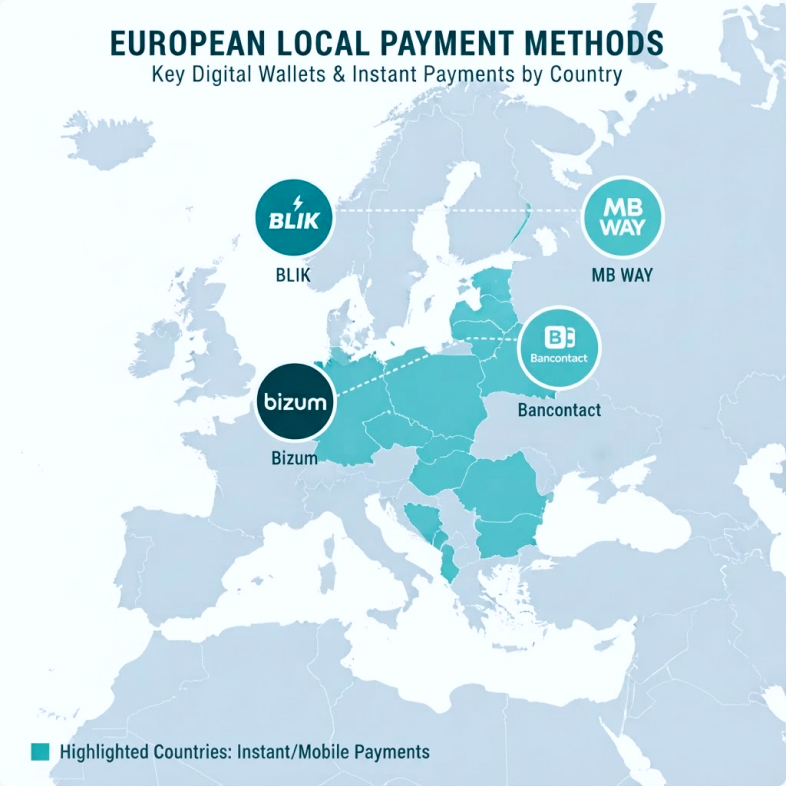
POLAND: BLIK
766.7M ecommerce payments in H1 2026, up 16% year on year
SPAIN: BIZUM
105.6M ecommerce purchases in 2025, up 82.1% year on year
BELGIUM: BANCONTACT
393M online mobile payments in 2025
PORTUGAL: MB WAY
185K+ businesses and merchants; 36% growth year on year during Easter 2026
Important Methodology Note:
These figures measure different aspects and periods of each payment ecosystem and should not be compared as market shares. They demonstrate the scale and continued relevance of locally embedded payment behaviour.
What The Data Tells Us
These examples demonstrate that locally embedded payment ecosystems can operate at substantial transaction or acceptance scale within individual European markets.
They should not be interpreted as evidence that these methods are replacing cards, or used to rank one local payment method against another.
The objective is not maximum payment choice. It is payment choice relevant to the markets being served, without adding unnecessary checkout or operational complexity.
Payment Strategy
The Traveller's Source Market Matters
Payment localisation changes how an international travel merchant can think about geography. The destination identifies where the travel product or service is being consumed. The source market identifies the payment environment from which the traveller is purchasing.
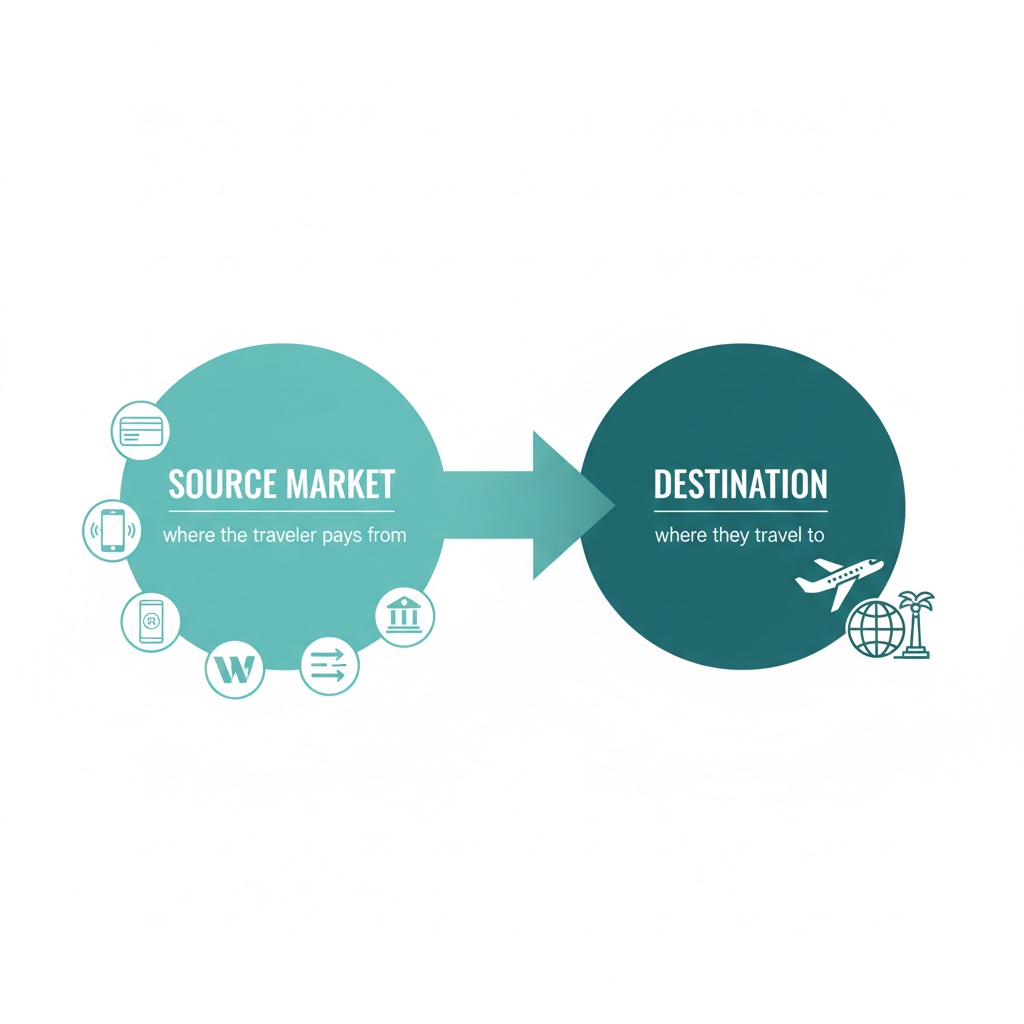
The preceding ECB data shows that online payment behaviour can differ substantially between European markets. The local payment method examples also demonstrate the scale of locally embedded payment ecosystems in individual countries.
What Can We Conclude From This?
For a cross-border OTA, destination data alone does not describe the customer's payment environment.
The evidence supports considering source-market payment behaviour when determining which payment options are relevant to customers.
Risk & Security
Risk, Fraud and the Payment Landscape
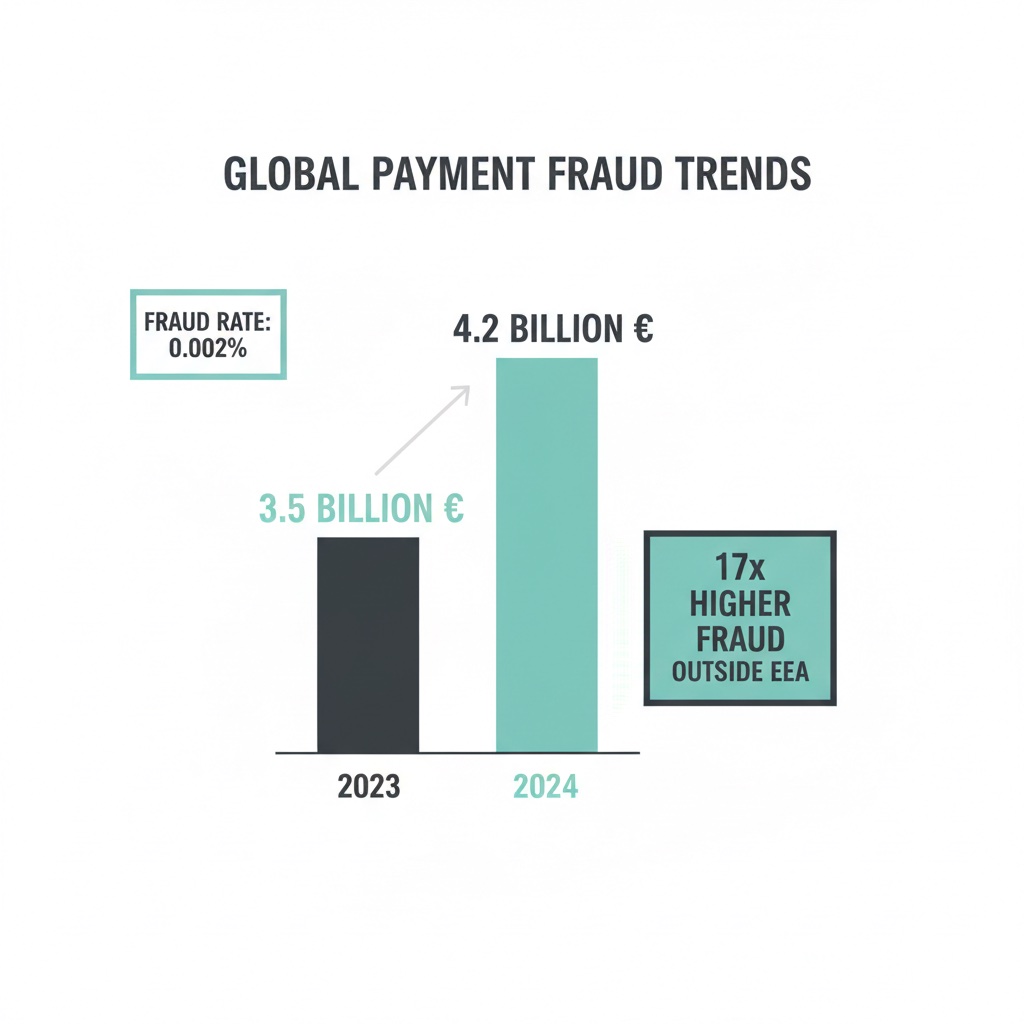
EBA/ECB data shows reported payment fraud increasing from 3.5 billion in 2023 to 4.2 billion in 2024, while the overall fraud rate remained around 0.002% of transaction value.
The EBA and ECB found that Strong Customer Authentication remains effective against the fraud types it was designed to mitigate, particularly card fraud, while fraudsters are adapting, including through payer manipulation.
Geography Matters To Fraud
The EBA and ECB note that card-payment fraud was 17 times higher where the payment recipient was outside the EEA, where SCA is not legally required and is often not used.
What The Data Tells Us
SCA remains an important fraud-control mechanism, but it does not address every form of payment fraud.
The data also shows that geography and authentication context are relevant considerations in cross-border card-payment risk.
Note: The 17x figure should not be interpreted as meaning that an individual cross-border travel transaction is 17 times more likely to be fraudulent. It refers specifically to the EBA/ECB comparison of card-payment fraud according to whether the payment recipient was inside or outside the EEA.
Cross-Border Payments
Payment Localisation and Cross-Border Complexity
Currency Transparency
Multi-currency pricing and Dynamic Currency Conversion, or DCC, are distinct mechanisms.
An OTA or hotel can present an online travel product in one of several supported currencies as part of the original ecommerce experience.
DCC occurs when a cardholder is offered the opportunity to pay in their home currency rather than the merchant's currency.
EU rules require applicable currency-conversion charges for card-based transactions to be expressed as a percentage mark-up over the latest available ECB reference rate.
What The Evidence Supports
Currency transparency is part of the cross-border payment experience.
The evidence in this report does not establish that displaying a customer's home currency increases conversion or that travellers universally prefer home-currency payment. No such claim is made.
Instant Payments and Regulatory Infrastructure
The EU Instant Payments Regulation has materially changed the infrastructure supporting euro credit transfers.
9 January 2025: Receiving instant euro payments became mandatory, and charges for instant transfers could no longer exceed corresponding standard-transfer charges.
9 October 2025: Sending instant euro payments became mandatory, with Verification of Payee also mandatory from that date.
Verification of Payee allows the payer to be informed of discrepancies between the account identifier and intended recipient's name before payment initiation.
What The Data Tells Us
The regulation strengthens the infrastructure supporting instant account-to-account euro payments.
The regulation does not establish that pay-by-bank will replace cards or that instant payments will become the preferred travel payment method.
The regulation concerns instant credit transfers and should not be described as creating a universal ecommerce product called pay-by-bank.
Extended Journey
The Extended Payment Journey
Travel payments can extend beyond the initial booking. A travel journey can involve multiple payment moments:
PRE-TRIP
Luggage, Insurance, Other advance purchases
BOOKING
Flights, Accommodation
IN-DESTINATION
Transport, Attractions, Dining
POST-TRIP
Amendments, Refunds, Other transactions
What This Means
The initial checkout does not necessarily represent the entire payment relationship associated with a trip.
For merchants and payment providers, different stages of the journey can create different payment-processing requirements.
The evidence therefore supports looking at travel payments as a lifecycle rather than only an initial checkout transaction.
Outlook
What The Evidence Means For Travel Payments
The evidence in this report supports one central conclusion: cross-border travel does not create uniform payment behaviour. Cards remain central to euro-area online payments, while e-payment solutions account for a significant share of transactions and locally embedded payment ecosystems operate at substantial scale in individual countries. For international travel merchants, source-market payment behaviour is relevant alongside destination. Payment localisation should be considered in terms of relevance to the market being served, rather than simply the number of payment methods offered. In European travel payments, cross-border reach and local payment relevance need to work together.
1. SOURCE MARKET MATTERS
EVIDENCE
Online payment behaviour differs significantly between European markets, while locally embedded payment ecosystems operate at substantial scale in individual countries.
CONCLUSION
For cross-border travel merchants, source-market payment behaviour provides relevant information that European averages alone cannot.
2. EUROPE IS A MULTI-METHOD PAYMENT ENVIRONMENT
EVIDENCE
Cards accounted for 48% of euro-area online payments in the ECB's latest comparable consumer study, while e-payment solutions accounted for 29%. Country-level differences are substantial.
CONCLUSION
The evidence does not support a simple narrative in which one payment method is replacing another. Cards remain central while other payment methods play significant roles in individual markets.
3. LOCALISATION IS ABOUT RELEVANCE
EVIDENCE
Payment behaviour varies by market, while local payment ecosystems show substantial scale in countries including Poland, Spain, Belgium and Portugal.
CONCLUSION
The relevant question is not simply how many payment methods can be offered, but which methods are relevant to the markets being served.
4. CROSS-BORDER COMPLEXITY
EVIDENCE
The report identifies multiple elements within international travel payments, including payment method choice, currency, SCA, fraud risk, instant payment infrastructure and payment activity beyond initial booking.
CONCLUSION
A straightforward customer payment experience can involve multiple operational, security and regulatory considerations.
Conclusion
Local Experience, Cross-Border Payments
The evidence in this report supports one central conclusion:
Cross-border travel does not create uniform payment behaviour.
Foreign-visitor accommodation nights grew faster than domestic nights in H1 2026, while the payment evidence shows significant differences between individual European markets.
Cards remain central to euro-area online payments. At the same time, e-payment solutions account for a significant share of transactions, and locally embedded payment ecosystems operate at substantial scale in individual countries.
The evidence therefore supports a multi-method view of European payments rather than a simple transition from one dominant payment method to another.
For international travel merchants, this makes source-market payment behaviour relevant alongside destination. A European average can describe the wider market, but it cannot capture all of the differences visible at country level.
Payment localisation should therefore be considered in terms of relevance to the market being served, rather than simply the number of payment methods offered.
The report also shows that cross-border travel payments involve more than payment-method acceptance. Currency transparency, authentication, fraud risk, instant-payment infrastructure and payment activity beyond the original booking can all form part of the wider payment environment.
The evidence does not point towards one European payment experience.
It points towards a cross-border travel market served by multiple payment methods, different domestic payment behaviours and an evolving European payments infrastructure.
For travel merchants and payment providers, the resulting challenge is to support payment experiences relevant to the markets being served while managing the operational, security and regulatory requirements behind them.
In European travel payments, cross-border reach and local payment relevance need to work together.
Sources and References
This report is based on the following principal sources:
Eurostat Tourism Accommodation Data (H1 2026)
European travel accommodation statistics used to assess foreign-visitor night growth compared with domestic night growth.
ECB SPACE 2024
Comparable euro-area consumer payment study data on online payment methods, including cards, e-payment solutions, credit transfers, direct debits and instant payments.
EBA and ECB Payment Fraud Monitoring Data
Reported payment fraud data, fraud rates and analysis of Strong Customer Authentication effectiveness.
Regulation (EU) 2024/886 (EU Instant Payments Regulation)
Regulatory requirements for instant euro payments, Verification of Payee provisions and related infrastructure changes.
National Payment Ecosystem Data
Transaction volumes and user growth data for BLIK (Poland), Bizum (Spain), Bancontact (Belgium) and MB Way (Portugal).
Disclaimer
This report is provided for general informational purposes only and does not constitute legal, regulatory, financial or professional advice. The information contained herein is based on publicly available sources as of the date of publication (September 2026) and may be subject to change. Readers should seek appropriate professional advice before making any decisions based on the contents of this report.
Ready to go beyond borders?
Talk to Griner: support@griner.io