
/
The Human Side of Payments: As Payments Scale and Automate, is Merchant Service Keeping Up?
The Human Side of Payments: As Payments Scale and Automate, is Merchant Service Keeping Up?
Oct 2026
•
12 min read

Executive Summary
The payments industry is transforming. Consolidation, technological advancement and automation are reshaping how payment companies operate. These changes bring clear benefits: greater efficiency, new capabilities, broader scale.
But they raise a different question for merchants: as the organization behind their payments changes structurally and technologically, is merchant service keeping pace?
This report investigates what consolidation, restructuring and automation could mean for continuity, responsiveness and the human knowledge merchants receive from their payment provider. It examines five specific implications and what the evidence suggests about merchant need.
The findings suggest this is worth examining closely.
1. The payments industry is consolidating and restructuring
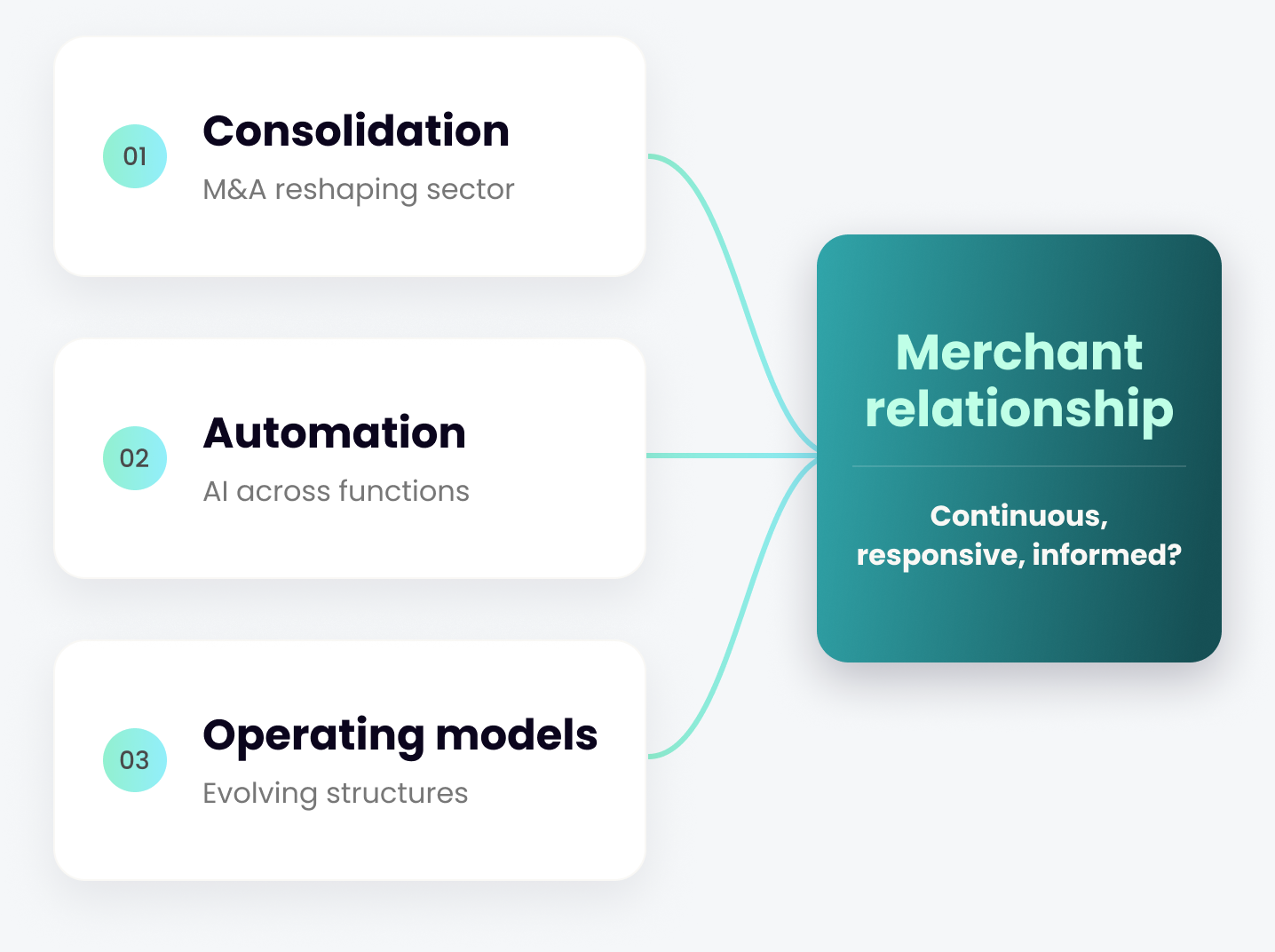
Recent consolidation and technology adoption are reshaping payment company operating models.
Between July and August 2026 alone, Windsor Drake Research identified significant M&A activity across the payments sector, with major transactions reshaping the competitive landscape. Simultaneously, BCG's 2026 research describes AI adoption across payment-company functions including onboarding, underwriting, fraud, disputes, servicing and operations.
The trend is clear: consolidation is happening, automation is expanding, and operating models are evolving alongside them.
For merchants, these changes create a practical question: during this transformation, does the relationship remain continuous, responsive and informed?
To answer that, consider what these structural changes could actually mean.
Sources: Windsor Drake Research, Payments M&A Activity Q3 2026; BCG, The AI-First Payments Company, 2026.
2. Losing an established point of contact
One immediate consequence of consolidation and restructuring is team change. An established merchant contact may depart, move to a different team or have their role eliminated.
This is not inherently problematic. Team change happens in every organisation.
The question is how knowledge and accountability move with that change. Does the new contact have access to the merchant's history? Can they answer questions about why previous decisions were made?
When consolidation happens quickly, or when cost reduction follows acquisition, the gap between "the person leaves" and "someone else knows what they knew" can be substantial.
For merchants, this can mean having to rebuild context with a new contact on issues where continuity matters.
3. New teams having to relearn the merchant and its business
Restructuring often means merchants are assigned to new account teams or service groups. The new team inherits a customer but not necessarily the institutional context: the payment setup, previous issues, unusual requirements, key contacts and why particular decisions were made.
Some of this may be documented. Some may exist only in email chains, old notes or the departing contact's memory. Some may not be recorded anywhere.
Relearning takes time. During that period, the merchant may experience slower problem-solving, repetitive questions and decisions made without full context. The team is essentially starting from the contract and working backwards, rather than starting from the relationship and working outward.
For merchants, this transition period is where maintaining service continuity can become particularly important.
4. Longer response and feedback times
Restructuring and cost reduction often mean flatter hierarchies and broader responsibilities. Remaining staff carry greater workloads. Account managers may handle more accounts. Technical teams may have wider remits.
Where restructuring results in broader account coverage or fewer people handling escalations, this can mean less time per account and longer response queues.
KAE's Merchant Lens 2026 research surveyed 216 UK merchants and found that customer service ranked alongside reliability and ease of use as important drivers of satisfaction.
For merchants, responsiveness is not a nice-to-have. It is a primary driver of whether they stay.
5. Overloaded teams creating friction internally
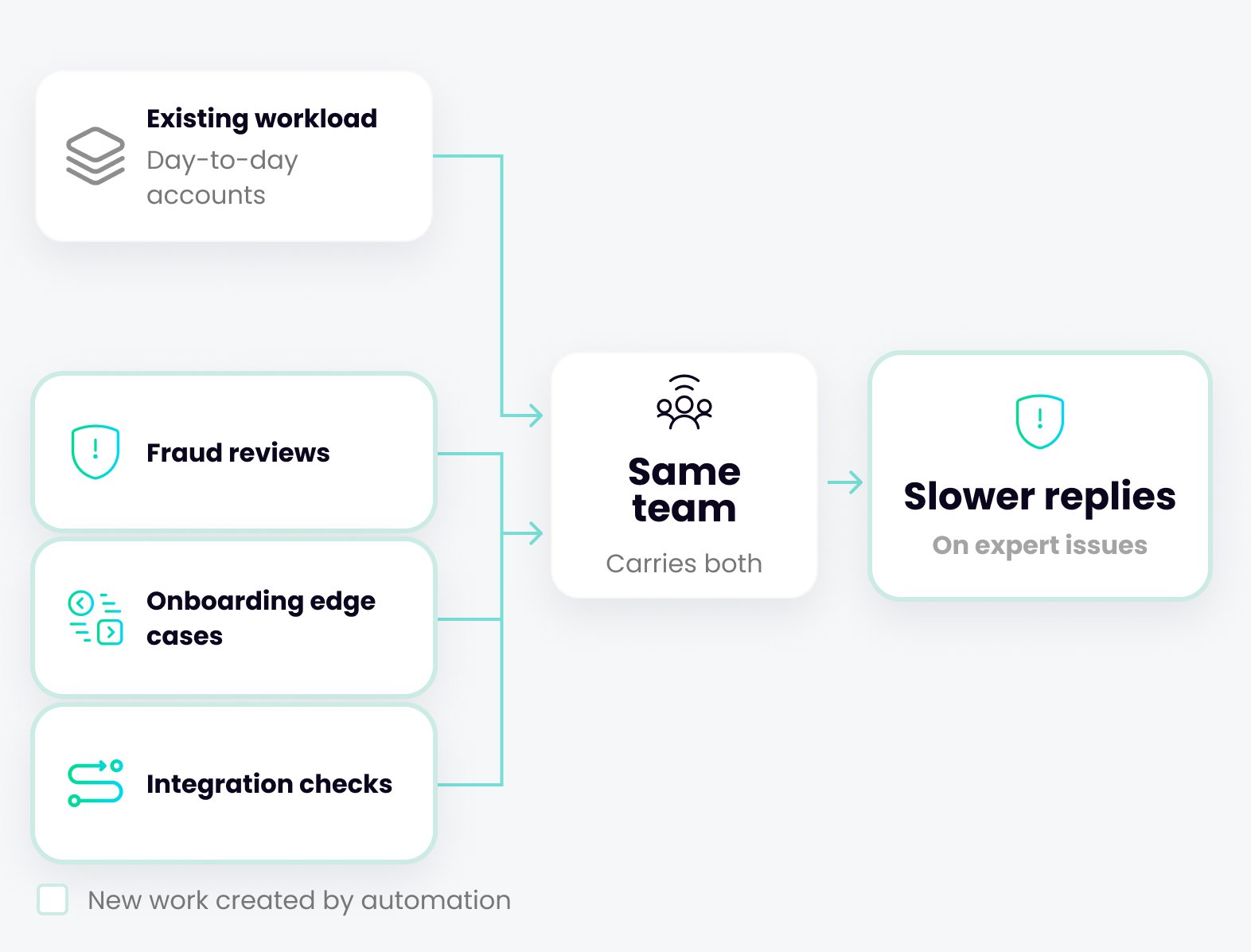
As payment companies consolidate and expand their use of automation, teams may also need to adapt to changes in responsibilities, processes and the level of human oversight required. A new fraud detection system may generate cases requiring manual review.
A new onboarding workflow may require human checking where exceptions or edge cases arise. Integration issues may also require investigation where an automated process does not operate as expected. During a transition period, teams may therefore need to manage both new automated processes and cases that continue to require human intervention, which can create additional operational pressure.
For merchants, this can mean delayed responses on issues where human expertise is precisely what's needed.
6. Immature automation creating friction
The introduction of new automation and AI systems can also involve a period of adjustment. Depending on the system and use case, implementation may involve false positives, edge cases or situations requiring additional human intervention while processes are refined.
BCG's 2026 research reports use cases producing 30% to 40% higher KYC productivity and more than 30% cost savings with 75% to 85% volume containment in servicing and operations. These are impressive figures. But they represent reported outcomes from specific implementations, not industry-wide averages. They also assume the systems have matured beyond their initial deployment.
These potential implementation challenges mean that the benefits of automation may not always be immediate. During a transition period, some cases may continue to require human verification or intervention while processes are refined. For merchants, this makes the quality of the transition important: where automated processes require additional human intervention, continuity and responsiveness remain relevant alongside the efficiencies the technology is intended to deliver.
7. So what could this mean for continuity, responsiveness and human knowledge?
These potential implications may not arise in isolation. Consider how they could interact in practice:
- 1.A merchant loses their established contact.
- 2.The new team has to relearn the business.
- 3.Meanwhile, the team is carrying heavier workloads because consolidation reduced headcount.
- 4.A new automation system has just rolled out and is creating false positives, requiring human checking.
- 5.Questions now take longer to answer.
Where these implications occur together, they can compound each other and test the resilience of the merchant relationship.
KAE's research reveals a satisfaction paradox: 92% of merchants were satisfied with their current provider. Yet 88% would recommend them and 94% could potentially be persuaded to switch. This reveals something critical: satisfaction does not equal loyalty. High satisfaction can coexist with fragility.
When asked what could trigger a review, merchants cited:
56%
High or increasing costs
41%
Technical issues
34%
Poor customer support
Cost is the most common trigger, particularly amongst smaller merchants. But technical issues and support sit alongside price as significant reasons merchants could reconsider their provider.
KAE identified other current frustrations including slow or unreliable settlement, integration difficulties, fraud and chargeback issues, and system downtime.
And the merchant's requirements are not fixed either.
In short: merchants need their providers to do two things simultaneously, a) handle the current relationship with continuity and responsiveness, and b) adapt as requirements change.
If consolidation and restructuring reduce continuity and responsiveness precisely during the period when merchants most need consistency, the provider is being tested under stress.

8. The handoff is where the system breaks
When merchants need help, what happens next reveals the real service model.
For routine requests, automation can work well. An automated onboarding process, automated fraud checks, automated settlement, these can be efficient when everything follows the standard path.
The challenge is the exception.
A business model changes. An integration behaves unexpectedly. Requirements span several markets. A technical problem needs investigation. A merchant has an unusual payment setup and the automated system doesn't know how to handle it.
At that point, the question is not whether automation has failed. It is what happens next.
Intrum's September 2026 European Consumer Payment Report found that 56% of 20,000 consumers across 20 European countries would trust AI more if they knew they could speak to a person when needed.
This is consumer research, not merchant research. But it illustrates a broader principle: automation and access to people can complement each other. The gap is the handoff.
For payment providers, the critical moment is when an issue moves from the automated system to a human. Information already provided should move with the issue. Ownership should remain clear. The next person should have context, not force the merchant to start again.
A handoff that forces the merchant to explain their situation twice is technically an escalation. It is not continuity.
And if the next person is overloaded, new to the account, or learning on the fly because the account knowledge didn't transfer, the handoff breaks under pressure.
Conclusion: Service architecture matters as much as technology
- 1.The payments industry is consolidating and automating. These changes bring benefits. But they test whether merchant service can scale at the same pace.
- 2.The risk is not consolidation or automation itself. The risk is implementing them in ways that erode continuity, responsiveness and human knowledge, precisely the things merchants rely on when the standard process doesn't work.
- 3.Merchants need providers who automate the routine and think carefully about the exceptions. Who invest in knowledge continuity during restructuring. Who keep responsiveness even as they scale.
- 4.That requires design. It requires that the merchant relationship is built with the same intentionality as the technology behind it.
Bottom line: As payments scale and consolidate, service architecture needs to scale too, paradoxically by staying up close and personal.
Global Payments Processing. Boutique Approach.
At Griner, we believe payment technology and personal service should work together.
Our boutique approach combines payment technology with direct human support from people who take the time to understand the business behind the payments.
Payments can be complicated. Working with your payment partner shouldn't be.
Talk to Griner: support@griner.io
Sources & Methodology
Windsor Drake Research, Payments M&A Activity: Q3 2026, August 25, 2026
Analysis of payments transactions announced between July 1 and August 25, 2026, verified against company announcements, regulatory filings or exchange releases.
PCN, Most In-Demand Fintech Jobs in 2026, September 16, 2026
Analysis of open roles across 30 European fintech and payments companies, including changes by function between Q1 and Q2 2026.
Boston Consulting Group, The AI-First Payments Company, April 23, 2026
Analysis of AI adoption and use cases across payment-company functions. Performance figures cited are reported use-case outcomes and are not presented as industry averages.
KAE, The Merchant Lens Report 2026, UK Market
Research amongst 216 UK merchants covering provider satisfaction, switching triggers, merchant requirements and future expectations.
Intrum, European Consumer Payment Report 2026, September 2026
Independent research conducted by FT Longitude, with fieldwork by SG Analytics from July 9 to August 20, 2026, covering 20,000 consumers across 20 European countries. It is included only as wider evidence concerning attitudes towards AI and human access and is not presented as merchant research.
Disclaimer
This report is provided for general informational purposes only and does not constitute legal, regulatory, financial or professional advice. Third-party findings are presented within the scope of their original research and should not be interpreted as representative of all merchants, payment providers or European markets.